China · Home-style
Red-Braised Pig's Trotters
Pig's trotters browned in caramel and braised until the meat slips from the bone, in a sauce dark with soy and thickened to a glaze.
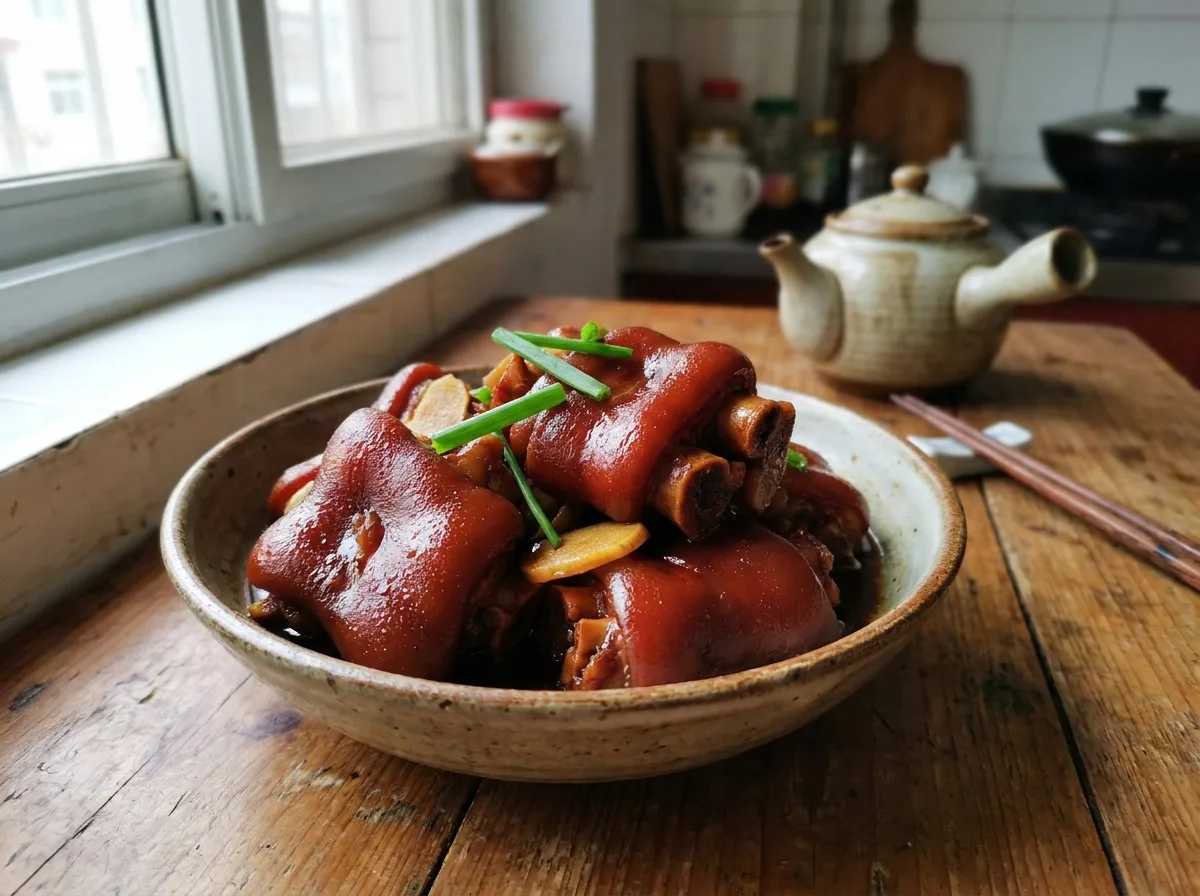
Trotters reward pressure cooking more than almost any other cut, and most home cooks who make them own a pressure cooker for exactly this reason. Browning the sugar separately is what gives the finished sauce its colour, and getting those trotters evenly caramelised on every surface takes more turning than people expect. Whatever liquid is left is worth keeping; the broth is better than the meat.
Ingredients
- pig's trotters3 pieces
- cooking oil30 ml
- bay leaves2 pieces
- ginger5 pieces
- cassia bark1 pieces
- cooking wine30 ml
- light soy sauce20 ml
- dark soy sauce20 ml
- salt8 g
- star anise4 pieces
Directions
- 1
Put the trotters, chopped by the stallholder, into cold water with 20 ml cooking wine, scallion and ginger, and boil for 15 minutes to draw out the raw smell.
- 2
Heat the pan and add cold oil, 30 ml, then 7 to 8 pieces of rock sugar over low heat, crushing it with the spatula, and cook for about 2 minutes until it turns to caramel.
- 3
Once the caramel has formed, add the blanched trotters and keep them moving over low heat until every piece is lightly golden on both sides.
- 4
Add 2 bay leaves, 1 piece of cassia bark, 4 star anise pods, 20 ml light soy sauce, 20 ml dark soy sauce, 10 ml cooking wine, 3 slices of ginger and 8 g salt, turn to medium heat, and keep stir-frying for 1 minute.
- 5
Add boiling or cold water to cover the trotters, cover, bring to the boil over high heat, then turn off the heat.
- 6
Pour everything from the pan into a pressure cooker and cook for 15 minutes; without a pressure cooker, simmer it in the pan instead.
- 7
After 15 minutes, transfer the trotters back to the wok, raise the heat and reduce the sauce. Taste with a chopstick and add 2 to 3 g salt if it is bland.
- 8
Reducing takes about 30 seconds, judged by how much liquid is in the pan; leaving more is fine, as the broth is excellent with rice.
Source: HowToCook · WorldBite adaptation · Unlicense source text; bilingual recipe adapted by WorldBite.